

Napier Art Deco and the 1931 earthquake
Stay Hawke’s Bay travel guide · checked 19 November 2026
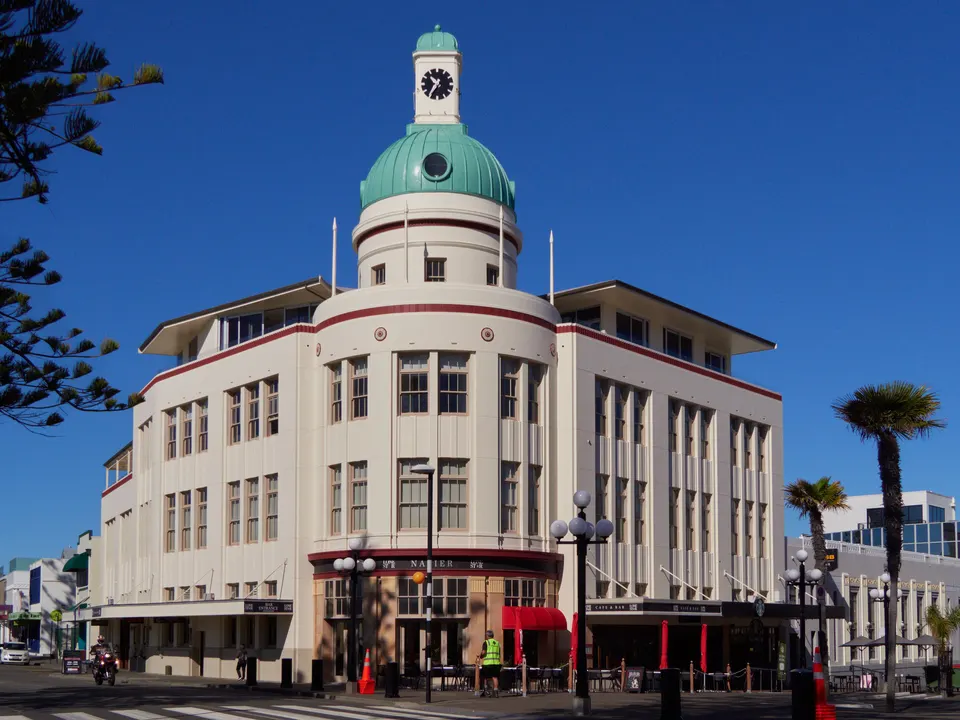
Napier is Art Deco because the Hawke’s Bay earthquake of 3 February 1931 and the fires after it destroyed most of the town centre, which was rebuilt in the styles of the early 1930s. The Art Deco Trust's guided walks start in Memorial Square and cover about 2 km of flat streets, or you can walk on your own.
Key facts
| Earthquake | 10.47am, Tuesday 3 February 1931. Magnitude 7.8 (Te Ara, NZHistory). |
|---|---|
| Deaths | 256 (official toll): 161 in Napier, 93 in Hastings, 2 in Wairoa |
| Land raised | Over 2,000 ha around Ahuriri Lagoon (Te Ara). GeoNet gives uplift of up to 2.7 m. |
| Rebuild | Central Napier was almost entirely rebuilt within about three years (Heritage NZ) |
| Styles | Art Deco, Spanish Mission, Stripped Classical, and Louis Hay's version of the Prairie style |
| Guided walks | From the Art Deco Trust, (former) Women's Rest, Memorial Square. From NZ$35. |
| Art Deco Festival | 18 to 21 February 2027 |
Why is Napier Art Deco?
Because the old town fell down and burned in 1931, at a time when Art Deco was the fashionable style. The earthquake and the fires that followed destroyed most of central Napier. Heritage New Zealand says the town was almost entirely rebuilt within about three years. To speed things up, the local architects J. A. Louis Hay, E. A. Williams, C. T. Natusch and Sons, and Finch and Westerholm worked together as the Associated Architects of Napier.
The Art Deco Trust gives three reasons for the choice. Napier wanted to look modern because its past had been wiped out. Reinforced concrete was seen as the safest material against earthquakes and fire, and flat, low-relief decoration could not crash onto the street the way heavy ornaments had in 1931. And moulded concrete decoration was cheap, which mattered: the rebuild happened in the Great Depression, and the Trust notes that few owners had earthquake insurance.
The result is a compact town centre from one short period. Heritage New Zealand listed 4.2 ha of it as the Napier City Centre Historic Area in 1995. Its report says Napier does not have the grandest Art Deco buildings in the world, but it has an unusual concentration of them.
What happened on 3 February 1931?
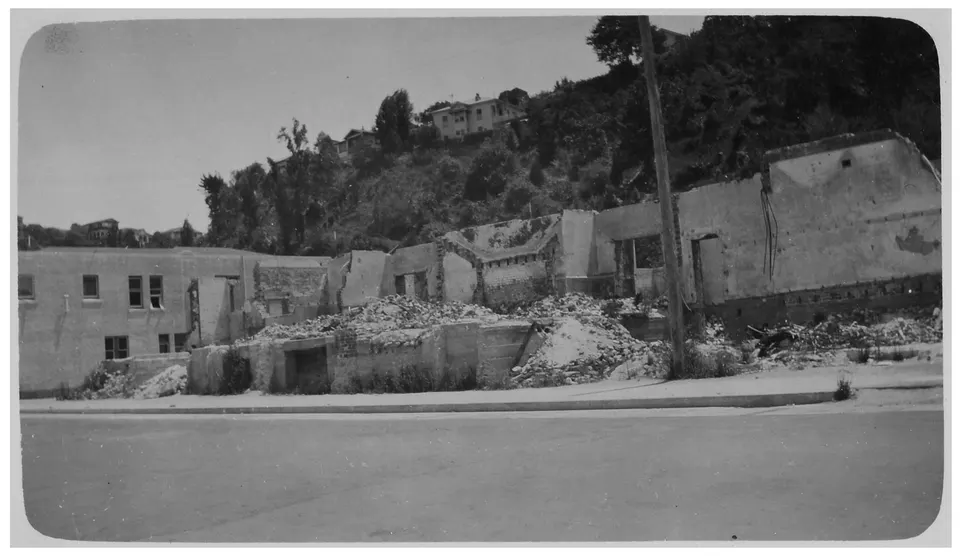
The earthquake struck at 10.47am on Tuesday 3 February 1931. GeoNet puts the centre about 20 km north of Napier, at a depth of about 20 km. Within minutes, fire broke out in three chemist shops in Napier. Te Ara says the fires gutted almost 11 blocks of the town centre and were put out about 36 hours later. In Hastings, fire also broke out in the business district.
The land moved a long way. GeoNet says the ground rose by up to 2.7 m near the mouth of the Arapaoanui River, north of Napier, and sank by up to 1 m at Hastings. Around Ahuriri Lagoon, Te Ara says over 2,000 ha of land were lifted out of the water. The Art Deco Trust's figure is 2,230 ha. That new land was later used for farms, industry, housing and Napier's airport. In the harbour, the sea floor rose and left the naval ship HMS Veronica aground.
Te Ara and NZHistory give the magnitude as 7.8. GeoNet's own listing gives several values: moment magnitude 7.4 to 7.6 and surface-wave magnitude 7.8. Many aftershocks followed. The largest, magnitude 7.3, came on 13 February 1931, offshore and about 50 km east of the first.
How many people died in the 1931 Napier earthquake?
The official death toll is 256: 161 in Napier, 93 in Hastings and 2 in Wairoa. NZHistory calls it the worst civil disaster in New Zealand. GeoNet adds that 593 people were seriously injured and taken to hospital.
You will see other numbers. The earthquake memorial in Napier lists 258 names, and the Art Deco Trust's fact sheet gives 261 deaths. We use the official figure of 256.
What styles will you see?
Napier was not rebuilt only in Art Deco. The Art Deco Trust's style guide sorts the buildings into several styles, with examples you can look for:
| Style | What to look for | Examples (Art Deco Trust) |
|---|---|---|
| Art Deco (Zig Zag Moderne) | Angular, geometric patterns used as decoration | Daily Telegraph Building, former Hotel Central, Masonic Hotel, Municipal Theatre |
| Spanish Mission | A style borrowed from California | Criterion Hotel, Provincial Hotel, Shakespeare Hotel, former State Cinema |
| Stripped Classical | Classical buildings simplified, flatter and with less decoration | State Insurance Building, A&B Building, Marine Parade Colonnade |
| Prairie style | An American Midwest style, used here by Louis Hay | Former Spa Hotel, Clive Square Community Centre, Bowmans Building |
| Chicago School | Very rare, after Louis Sullivan's buildings in Chicago | National Tobacco Company Building |
Napier Art Deco buildings: which ones can you see?
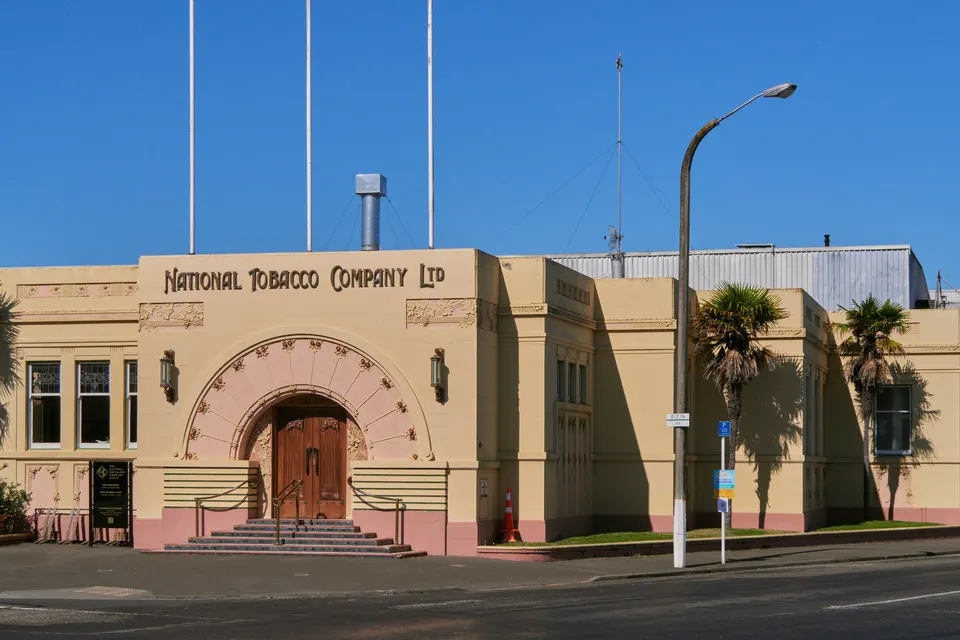
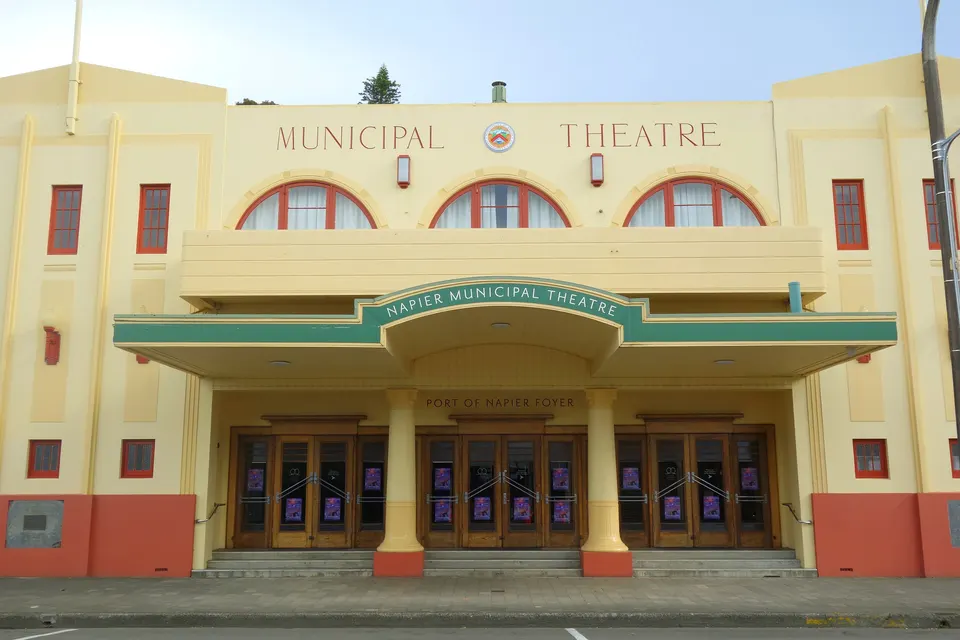
These are all on the New Zealand Heritage List as Category 1 historic places. Most are working shops, offices and venues, so you see them from the street.
| Building | Where | Built | Why look |
|---|---|---|---|
| Daily Telegraph Building | 49 Tennyson Street | Designed 1932, finished May 1933 | E. A. Williams' design, which Heritage NZ calls one of Napier's outstanding Art Deco buildings |
| Bank of New Zealand (Former) | 100 Hastings Street | 1933–34, opened 5 November 1934 | Māori patterns: whale and wave motifs outside, painted kōwhaiwhai on the banking chamber ceiling |
| National Tobacco Company Building | 1 Ossian Street and Bridge Street, Ahuriri | Entrance rebuilt in 1933 | Louis Hay's entrance with raupō and roses sculpted in concrete |
| T & G Building | Corner of Marine Parade and Emerson Street | Started 1935 | Stripped Classical, three storeys and a tower |
| Municipal Theatre | 119 Tennyson Street | Opened June 1938 | Art Deco theatre by Borough Architect J. T. Watson, replacing a theatre lost in 1931 |
Sources do not always agree on labels. Heritage NZ describes the National Tobacco Company Building as Art Nouveau or Secession style with Art Deco touches, such as the sunburst in the central arch. The Art Deco Trust puts it in the Chicago School.
The Art Deco Trust itself is in the (former) Women's Rest in Memorial Square. Louis Hay designed it in 1924, and it opened on Anzac Day 1926 as a war memorial and a place of rest for women and children.
How do you do an Art Deco walk in Napier, and what does it cost?
The Art Deco Trust runs guided walks from its centre in the (former) Women's Rest, Memorial Square, 5 Clive Square East. Every tour starts with a 20-minute film about the earthquake, The Day that Changed the Bay. You need to be able to walk about 2 km on flat ground with some steps. Prices on the Trust's website on 19 November 2026:
| Walk | When | Length | Price |
|---|---|---|---|
| Guided 10am | Year-round | 1 hr 30 min (film and a 1-hour walk) | From NZ$35 |
| Guided 2pm | Year-round | Summer: introduction, film and a 1.5-hour walk. Winter: film and a 1-hour walk. | From NZ$37.50 (winter from NZ$35) |
| Guided 4.30pm | Some days, 1 October to 31 March only | 2 hr | From NZ$36.50 (adult) |
| Self-guided walk | Any time | About 1 hr 30 min | NZ$10 (PDF for your phone), NZ$20 (printed, from the Art Deco Trust shop) |
The Trust calls the 2pm walk its most complete tour, and lists it at 2 hours 30 minutes. Book ahead: the 4.30pm walk needs at least 48 hours' notice. Cancelling within 48 hours costs 30% of the booking, and on the day the full price. Prices can change, so check the walking tours page.
The Art Deco Trust is open 7 days, 9am to 5pm from 1 October to 31 March and 9.30am to 2.30pm from 1 April to 30 September. It also offers tours in vintage cars.
Did Hastings rebuild in the same style?
Partly, and with more Spanish Mission. Hastings lost 93 people in the earthquake. The Art Deco Trust notes that its water supply held, so its fires could be contained. Heritage New Zealand lists Russell Street in central Hastings as a historic area for its many Spanish Mission and Art Deco buildings, rebuilt cheaply during the Depression.
Two buildings to look for on Heretaunga Street: the former Westerman's and Co. Building on the corner of Russell Street South, designed by Edmund Anscombe and started in 1931, in the Spanish Mission style, and Villa d'Este at 341–351 Heretaunga Street West, a Spanish Mission building from 1929 that was badly damaged and rebuilt in 1932. The former Hastings Municipal Theatre on Hastings Street South is older (1915) and already Spanish Mission outside; it was strengthened after the earthquake.
Where can you learn more about the earthquake?
The museum at 1 Tennyson Street in Napier (MTG Hawke’s Bay, whose website now uses the name Kahukura Hawke’s Bay Museum) has had a redeveloped exhibition on the earthquake, Shockwave: Hawke’s Bay's Great Quake, 1931, since 2025. It tells personal stories of survival and loss, explains who Rūaumoko is, and has a shake house where you can feel what an earthquake is like. It was made with the Natural Hazards Commission Toka Tū Ake. Entry to the galleries is free, and the museum is open 7 days, 9.30am to 5pm.
Every February the Art Deco Trust runs the Art Deco Festival Napier, with vintage cars, jazz and 1930s dress. The next one is from 18 to 21 February 2027, and its programme includes a 1931 earthquake commemoration lecture on 17 February. See our page on the [Art Deco Festival Napier 2027](/events/art-deco-festival-napier-2027/).
Questions
How much is an Art Deco tour in Napier?
The Art Deco Trust's guided walks start at NZ$35 (10am), NZ$37.50 (2pm in summer) and NZ$36.50 for adults (4.30pm, summer only). The self-guided walk costs NZ$10 as a download or NZ$20 printed. Prices are from the Trust's website on 19 November 2026.
How long does the Art Deco walk take?
The 10am guided tour takes 1 hour 30 minutes, including a 20-minute film. The 2pm tour is longer, up to 2 hours 30 minutes in summer. The self-guided walk takes about 1 hour 30 minutes.
Where does the Art Deco walk start?
At the Art Deco Trust in the (former) Women's Rest, Memorial Square, 5 Clive Square East, in central Napier.
Why did Napier choose Art Deco?
It was the modern style of the time, its low-relief concrete decoration was safer in an earthquake than heavy ornaments, and it was cheap to build during the Depression.
When is the Art Deco Festival in Napier?
The 2027 festival runs from Thursday 18 to Sunday 21 February 2027. The Art Deco Trust has published 17 to 20 February for 2028.
Sources
Checked 19 November 2026 against these sources. Rules, prices and times change, so check the official page before you go. How we check facts
- NZHistory (Manatū Taonga): Hawke’s Bay earthquake
- Te Ara: Historic earthquakes – The 1931 Hawke’s Bay earthquake
- Te Ara: Hawke’s Bay region – 20th-century developments
- GeoNet: M 7.4 Hawke’s Bay earthquake, 3 February 1931
- Heritage New Zealand: Napier City Centre Historic Area (List No. 7022)
- Heritage New Zealand: Daily Telegraph Building (List No. 1129)
- Heritage New Zealand: Bank of New Zealand (Former) (List No. 1112)
- Heritage New Zealand: National Tobacco Company Building (List No. 1170)
- Heritage New Zealand: T & G Building (List No. 183)
- Heritage New Zealand: Municipal Theatre (List No. 4980)
- Heritage New Zealand: Russell Street Historic Area, Hastings (List No. 7020)
- Heritage New Zealand: Westerman's and Co. Building (Former), Hastings (List No. 178)
- Heritage New Zealand: Villa d'Este, Hastings (List No. 1103)
- Heritage New Zealand: Hastings Municipal Theatre (Former) (List No. 1096)
- Art Deco Trust: Art Deco
- Art Deco Trust: Why Deco (PDF)
- Art Deco Trust: Architectural styles (PDF)
- Art Deco Trust: Earthquake facts (PDF)
- Art Deco Trust: Walking tours
- Art Deco Trust: Guided 10am walk
- Art Deco Trust: Guided 2pm walk
- Art Deco Trust: Guided 4.30pm walk
- Art Deco Trust: Self guided walk
- Art Deco Trust: Contact us (address and opening hours)
- Art Deco Trust: (former) Women's Rest
- Hawke’s Bay Museum (MTG Hawke’s Bay): Shockwave – Hawke’s Bay's Great Quake, 1931
- Natural Hazards Commission Toka Tū Ake: Feel the shake without the risk at MTG Hawke’s Bay
- Kahukura Hawke’s Bay Museum: Visit
- Art Deco Festival Napier: Future festival dates
- Art Deco Festival Napier 2027 programme (PDF)